Tutorial 8
FOL
Building formulas
Build each target from terms and formulas using the formation rules. Select arguments in order before choosing a function, predicate, or connective. For quantification, select a formula and the variable to bind. The first level asks for a term; the remaining levels ask for formulas.
Enable JavaScript to use these exercises.
Scope and binding
Mark every quantifier’s bindings. Select a quantifier, then the variable occurrences it binds; select another quantifier to continue. Leave free occurrences unconnected. Visit a vacuous quantifier too, but give it no arrows. Check the completed diagram.
Enable JavaScript to explore variable binding.
Decoding FOL
Paraphrase the following FOL formulas in natural language:
-
∃x (FatherOf(x, brotherOf(jimmy)) ∧ ¬FatherOf(x, jimmy))
-
∀x (Fish(x) → ∃y (Fish(y) ∧ BiggerThan(y, x)))
-
(∃x Sibling(jimmy, x) → ∃x (Sibling(jimmy, x) ∧ ∀y (Sibling(x, y) → YoungerThan(y, x))))
-
∃x ∃y (Thief(x) ∧ Thief(y) ∧ x ≠ y)
-
∃y ∀x Likes(x, y)
-
∀x ∃y Likes(x, y)
-
∃x (Key(x) ∧ Opens(x, door) ∧ ∀y ((Key(y) ∧ Opens(y, door)) → y = x))
-
¬∃x (Human(x) ∧ ∀y Knows(x, y))
-
∀x (Sibling(x, jimmy) → x ≠ jimmy)
Solution
-
There is a person who’s the father of Jimmy’s brother but not Jimmy’s father.
-
For each fish, there’s a bigger fish.
-
If Jimmy has a sibling at all, then one of Jimmy’s siblings is older than all of their siblings.
-
There are at least two different thieves.
-
There is someone whom everyone likes.
-
Everyone likes someone, possibly a different person in each case.
-
Exactly one key opens the door.
-
No human knows everyone.
-
None of Jimmy’s siblings is Jimmy himself.
Substitution
Substitution replaces the free occurrences of a variable by a term. Let’s work out its recursive definition. Write E[t/x] for replacing x by t in a term or formula E.
-
Parse R(g(x, a), f(x)). Replace x by f(y) at the leaves and rebuild the tree upward. What happens at a variable different from x? At a constant?
The interactive tree is loading. The explanation in the chapter can also be followed without it.Enable JavaScript to step through the tree. The grammar and worked example remain available in the chapter.
-
Write recursive clauses for variables, constants, function applications, predicate applications, identity, and the propositional connectives. Which clauses have the same pattern?
-
Consider (P(x) ∧ ∀x Q(x))[a/x]. Which occurrence changes, and why must substitution stop at the quantifier?
-
Now try (∃y R(x, y))[y/x]. Blind replacement gives ∃y R(y, y). Why is this wrong? Compare “the object assigned to y relates to something” with “something relates to itself”. Rename the bound y to a fresh z before substituting. What condition tells us that such renaming is needed?
-
Combine your clauses in the algorithm below. Here an application includes function and predicate applications and identity;
rebuildkeeps the original operator and uses the new children.free_variablesapplies to both terms and formulas.rename_free(B, y, z)renames the free occurrences of y in B, stopping at inner quantifiers that bind y.fresh_variable(E, t, x)chooses a variable absent from E and t and different from x. Why is no renaming needed when x is not free in B?
Enable JavaScript to use these exercises.
Solution
-
The result is R(g(f(y), a), f(f(y))). Replace a variable equal to x by t; leave other variables and constants alone.
-
Substitute recursively in every immediate child, then rebuild the application or connective with those children. For example,
f(u₁, …, uₙ)[t/x] = f(u₁[t/x], …, uₙ[t/x]) (A ∧ B)[t/x] = (A[t/x] ∧ B[t/x]). -
Only the first occurrence is free, so the result is (P(a) ∧ ∀x Q(x)).
-
The inserted y must remain free. Rename the existential binder first, obtaining ∃z R(x, z), then substitute to get ∃z R(y, z). Renaming is needed when substitution reaches a quantifier whose variable is free in the replacement term.
-
For Q ∈ {∀, ∃}, leave Qy B unchanged when y = x or x is not free in B. Otherwise, if y is free in t, first rename its bound occurrences to a fresh variable. Then substitute in the scope and restore the quantifier. If x is absent, nothing is inserted, so nothing can be captured.
Knowledge Engineering in FOL
Knowledge engineering (opens in a new tab) is the complex process of developing a framework in which to encode knowledge about a specific domain. There are different approaches to this problem, but here we’ll try out an FOL-based approach.
The problem we’re tackling is to represent information about a given setup using FOL formulas. The first step in the approach is to decide on a suitable vocabulary. Since we’re working with FOL languages, this means that we need to pick suitable constants, function symbols, and predicates to represent the information. Picking the right vocabulary is crucial for success when dealing with a knowledge engineering problem: choosing the wrong vocabulary can make representations clunky and hard to work with, even if—in some sense—still correct.
Picking the right language is closely related to finding a suitable ontology (opens in a new tab) for the problem. That is, we need to say which objects exist in the information, which functions and properties are at play. We also need to answer questions like whether we can reduce some properties to others to have a simpler language. For example, should we have a separate predicate for Uncle² or should we define it using Male¹, Sibling², and Parent², where rather than Uncle(x, y) we use:
Uncle(x, y) is much simpler, but the previous formula contains more information. There is a trade-off that needs to be weighed carefully for every proposed knowledge engineering solution.
The second step in FOL knowledge engineering is to take the given information and to encode it with FOL formulas. Here, the main challenge is adequacy: we need to find formulas whose FOL truth-conditions resemble the given information as closely as possible, while remaining within the confines of FOL.
For a concrete knowledge engineering problem, let’s consider the following marketing information about provided by its developer:
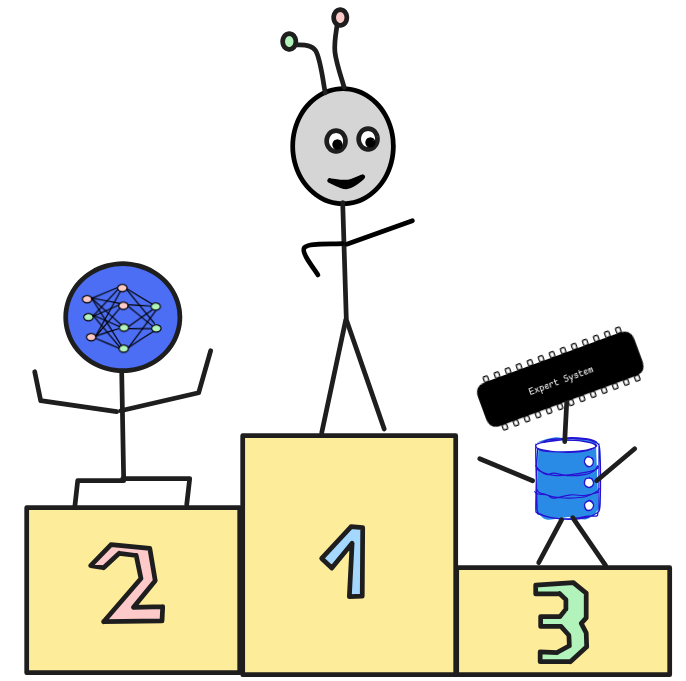 Our
is the top-of-the-line AI system from AI-Labs. It is
a hybrid system that has both symbolic and sub-symbolic sub-routines. This means
that
is both capable of carrying out all traditional
reasoning tasks, such as natural deduction or SAT solving, as well as
different learned tasks, such as image and voice recognition. This is in
contrast to its predecessor model KnowIt∀, which only had symbolic routines
and could only carry out reasoning tasks. It also makes
superior to
the competition’s model, DeepL, which is a purely sub-symbolic AI-system and
while able to carry out all learned tasks, can only carry out some simple
reasoning tasks.
Our
is the top-of-the-line AI system from AI-Labs. It is
a hybrid system that has both symbolic and sub-symbolic sub-routines. This means
that
is both capable of carrying out all traditional
reasoning tasks, such as natural deduction or SAT solving, as well as
different learned tasks, such as image and voice recognition. This is in
contrast to its predecessor model KnowIt∀, which only had symbolic routines
and could only carry out reasoning tasks. It also makes
superior to
the competition’s model, DeepL, which is a purely sub-symbolic AI-system and
while able to carry out all learned tasks, can only carry out some simple
reasoning tasks.
-
Devise a suitable FOL language for encoding the information about the three AI-systems. Justify your design choices.
-
Encode as much information as possible from the advert as FOL formulas. Is there information you chose not to include? If so, why?
-
What assumptions would a total function makerOf impose? Compare it with a binary relation IsMakerOf. Which suits the information given?
Solution
-
There are different ways of doing this. One way to go is this:
-
Constants: AllAI, KnowItAll, DeepL, imageRecognition, voiceRecognition, naturalDeduction, satSolving
-
Predicates: IsSymbolic¹, IsSubSymbolic¹, IsReasoningTask¹, IsLearnedTask¹, IsCapableOf²
This language has names for certain tasks, like voice recognition or natural deduction, which means that it includes them in its ontology. This means, for example, that in models of that language these tasks will be objects in the domain. An alternative approach would be to include corresponding properties, like IsCapableOfNaturalDeduction¹, which however leads to a proliferation of predicates.
-
-
Using AllAI and KnowItAll as constants for the advertised systems, we can write:
- IsSymbolic(AllAI) ∧ IsSubSymbolic(AllAI)
- ∀x (IsReasoningTask(x) → IsCapableOf(AllAI, x))
- ∃x (IsLearnedTask(x) ∧ IsCapableOf(AllAI, x))
- IsCapableOf(AllAI, naturalDeduction), IsCapableOf(AllAI, satSolving)
- IsCapableOf(AllAI, voiceRecognition), IsCapableOf(AllAI, imageRecognition)
- IsSymbolic(KnowItAll) ∧ ¬IsSubSymbolic(KnowItAll)
- ∀x (IsCapableOf(KnowItAll, x) → IsReasoningTask(x))
- ¬IsSymbolic(DeepL) ∧ IsSubSymbolic(DeepL)
- ∀x (IsLearnedTask(x) → IsCapableOf(DeepL, x))
- ∃x (IsReasoningTask(x) ∧ IsCapableOf(DeepL, x))
Reading “some” as “some but not all” adds: ∃x (IsReasoningTask(x) ∧ ¬IsCapableOf(DeepL, x))
-
We might add a constant aiLabs and a predicate IsMakerOf² to the language to say that:
- IsMakerOf(aiLabs, AllAI)
The alternative of adding a function symbol makerOf and writing makerOf(AllAI) = aiLabs requires exactly one maker for every object in the domain, including aiLabs itself. That’s a modeling assumption, not a mistake in the syntax. If objects can have no maker or several makers, the binary relation is a better fit. A suitably restricted domain could make the function appropriate.
Knowledge Representation with FOL Models
For this exercise, we are working with an FOL language with the following vocabulary:
-
Constants: jimmy, linus, sir, lady, gran, ny, london, soccer
-
Predicates: Loves², IsFrom², ParentOf², LivesIn²
Now consider the following facts about our protagonist, little Jimmy:
Little Jimmy and his brother, Linus, are the children of Mr Sir and Lady Dame. The family lives in New York, where Lady Dame is from. But both Jimmy and his brother were born in London, where their father is from. The children’s paternal grandmother is Granny Smith, who still lives in London, where she was born. The children and their grandmother love soccer, unlike their parents.
-
Represent the information as a FOL model. Specify the model in set-theoretic terms, as a knowledge graph, and in table form. Make sure to include the information about which constant denotes which object.
-
Write the SQL statements that create and populate the relation tables. Use the same column order as your model. The DB initialization exercise below lets you practice this step with automatic feedback.
-
In logic, there is the concept of a diagram (opens in a new tab) , which is, essentially, the idea of collecting all the true atomic sentences and true negations of atomic sentences in the model. The positive diagram is the set of only the true atomic sentences, without the true negated ones. Determine the positive diagram of the model we’ve just described. Is this essentially different from any of the other methods of representing the model?
Solution
-
These presentations specify the same model. An absent tuple is false; this completes the information supplied by the description.
Model DatabaseEach run starts with an empty database. Powered by sql.jsEnable JavaScript to use the model canvas. The definitions and worked examples remain available.
-
Create one table for each of Loves, IsFrom, LivesIn, and ParentOf, with two text columns and a composite primary key. Insert the rows shown above. Add Domain(value) if queries should range over all eight objects. For example:
Each run starts with an empty database. Powered by sql.jsEnable JavaScript to edit and run this SQL.
-
It’s not really different from any of the previous methods. Here’s what we get:
- Loves(jimmy, soccer)
- Loves(linus, soccer)
- Loves(gran, soccer)
- IsFrom(jimmy, london)
- IsFrom(linus, london)
- IsFrom(sir, london)
- IsFrom(lady, ny)
- IsFrom(gran, london)
- LivesIn(jimmy, ny)
- LivesIn(linus, ny)
- LivesIn(sir, ny)
- LivesIn(lady, ny)
- LivesIn(gran, london)
- ParentOf(sir, jimmy)
- ParentOf(sir, linus)
- ParentOf(lady, jimmy)
- ParentOf(lady, linus)
- ParentOf(gran, sir)
Identity contributes c = c for each of the eight constants c. Distinct constants denote distinct objects in this model.
The full atomic diagram is much larger, since there are plenty of false atoms, like ParentOf(soccer, ny), so their negations are all true, including ¬ParentOf(soccer, ny).
Denotation
Suppose that we’re working with an FOL language that has the single constant null, as well as the function symbols succ¹ and prod².
Consider the model whose domain D = { 0, 1, 2, … } is the set of natural numbers and where:
- ⟦null⟧ = 0
- ⟦succ⟧ is defined by the equation ⟦succ⟧(n) = n + 1 for all n ∈ { 0, 1, 2, … }.
- ⟦prod⟧ is defined by the equation ⟦prod⟧(n, m) = n × m for all n, m ∈ { 0, 1, 2, … }.
In this model, determine:
Parse the term, then calculate its value from the leaves upward.
Solution
Enable JavaScript to step through the tree. The grammar and worked example remain available in the chapter.
The calculation follows the same tree:
| Term t | Value ⟦t⟧ |
|---|---|
| null | 0 |
| succ(null) | 0 + 1 = 1 |
| succ(succ(null)) | 1 + 1 = 2 |
| prod(succ(succ(null)), succ(null)) | 2 × 1 = 2 |
| prod(succ(null), prod(succ(succ(null)), succ(null))) | 1 × 2 = 2 |
Building models
Build a model in which the formula has the requested truth value. The pictures identify objects; you choose the constants’ denotations and predicate extensions. An object’s appearance imposes no further conditions on the model. If no model can have the requested truth value, choose Impossible and explain why. You may use loops in BiggerThan: the name alone imposes no restrictions.
Enable JavaScript to use the model canvas. The definitions and worked examples remain available.
Enable JavaScript to use these exercises.
Extensions
Select the extension of each formula in Jimmy’s family model. The model’s tables show the relevant information; the selection canvas contains the domain or its product. A selected pair is ordered: its first object supplies the value of x, its second the value of y.
Enable JavaScript to use these exercises.
Extensions and set operations
Suppose A(x) and B(x) each have just x free. Prove the following using the satisfaction clauses. Start with an arbitrary d ∈ D and ask when it belongs to each side.
- ⟦A(x) ∧ B(x)⟧ᴹ = ⟦A(x)⟧ᴹ ∩ ⟦B(x)⟧ᴹ.
- ⟦A(x) ∨ B(x)⟧ᴹ = ⟦A(x)⟧ᴹ ∪ ⟦B(x)⟧ᴹ.
- ⟦¬A(x)⟧ᴹ = D ∖ ⟦A(x)⟧ᴹ.
Solution
For conjunction, d ∈ ⟦A(x) ∧ B(x)⟧ᴹ iff M ⊨ A(d) ∧ B(d), iff both M ⊨ A(d) and M ⊨ B(d), iff d belongs to both extensions. This is membership in their intersection. For disjunction, replace “both” by “at least one”, giving the union. For negation, d satisfies ¬A exactly when it does not satisfy A, giving the complement within D.
DB initialization
Create the tables shown in each level and insert exactly their rows. Use the displayed table and column names, with text identifiers for the objects. The first levels ask for one relation; the last asks for the whole database, including Domain(value). Run checks the resulting tables.
Enable JavaScript to edit and run this SQL.
Enable JavaScript to use these exercises.
SQL queries
Translate each formula into a query returning its extension. The database is already initialized. Quantifiers and free variables range over all 18 objects in Domain, including cities, continents, and languages. Follow the displayed column order and return each tuple only once.
The levels progress from atoms through the connectives and quantifiers to compound queries. Work recursively: translate the immediate parts of the formula, then combine their conditions using the rule for the main operator. Run checks your answer on this database.
Enable JavaScript to edit and run this SQL.
Enable JavaScript to use these exercises.
Solution
For LocatedIn(x, Europe), one solution is:
This returns France, the United Kingdom, and Greece. For x = Japan, replace
the condition by d.value = 'Japan'. To negate an atom, put NOT before its
EXISTS test. Translate conjunction and disjunction by combining the complete
conditions with AND and OR; use (NOT a) OR b for implication and
(a AND b) OR ((NOT a) AND (NOT b)) for the biconditional.
For ∃y CapitalOf(y, x), search for a value of y:
The answer contains the five capitals. For a universal quantifier, search for
a counterexample with NOT EXISTS (... WHERE NOT (...)). Each further
quantifier adds its own domain alias. The worked universal query and the
nested European-capital query in the textbook illustrate the remaining steps.
A successful run establishes agreement on the displayed database. A correct translation must return the formula’s extension in every database with this language and these conventions; explain why your construction does so.
Queries with JOIN
SQL offers shorter ways to express some queries. In the country database,
use JOIN LocatedIn ON CapitalOf.country = LocatedIn.country to combine
rows that agree on the country. Add a WHERE condition to return just
the European capitals. Compare the result with the recursive translation
of ∃y (CapitalOf(y, x) ∧ LocatedIn(y, Europe)).
Enable JavaScript to edit and run this SQL.
Solution
The join supplies the shared country; the condition restricts its continent:
Enable JavaScript to edit and run this SQL.
Requiring an infinite model
Use a language with one binary predicate <, written between its arguments. Its interpretation need not be the usual less-than relation.
- In the standard number model, D = ℕ and ⟦<⟧ is the usual less-than relation. Explain why ∀x ∃y (x < y) is true. Given a value n for x, which value can you choose for y?
- Find a finite model of the same sentence. Try one object first. Which ordered pairs must belong to ⟦<⟧? Why does the predicate’s name not prevent this interpretation?
- Add the requirement that < is irreflexive: nothing is related to itself. Write it as a formula. Can two objects still give a finite model of both sentences? Draw its arrows.
- Also require transitivity: if x < y and y < z, then x < z. Write this as a formula. What does transitivity do to a cycle of arrows? Why does irreflexivity then rule the cycle out?
- Collect your three sentences into a knowledge base. Explain why it has an infinite model but no finite model. Hint: keep following the witnesses supplied by the first sentence. What must happen in a finite domain?
Solution
-
For each n ∈ ℕ, choose n + 1. This gives a witness for the existential quantifier, whatever value the universal quantifier supplies.
-
Take D = {d} and ⟦<⟧ = {[d, d]}. The only object supplies its own witness. FOL imposes no ordering conditions on a predicate just because we write it as <.
-
Irreflexivity is ∀x ¬(x < x). The two-object model with ⟦<⟧ = {[d, e], [e, d]} satisfies this and ∀x ∃y (x < y). Each object has a successor, and neither is related to itself.
-
Transitivity is ∀x ∀y ∀z ((x < y ∧ y < z) → x < z). Repeatedly applying it to a cycle gives a relation from its starting object back to itself, contradicting irreflexivity.
-
The knowledge base is:
{∀x ∃y (x < y), ∀x ¬(x < x), ∀x ∀y ∀z ((x < y ∧ y < z) → x < z)}.The standard number model satisfies all three sentences. In a finite nonempty domain, repeatedly choosing a successor eventually revisits an object. That creates a cycle, which the other two sentences exclude. So every model of this knowledge base is infinite.